How to Choose the Best AI Task Automation Tools for Multi Step Workflows
You are comparing AI automation tools for several-step operations, and the differences between them go far beyond price tags. Most teams pick a tool based on a demo, then discover integration limits or setup friction only after deployment. That is why this guide cuts through the marketing.
By the end of this article, you will know the five core capabilities that separate capable multi-step automation tools from basic ones, see a clear breakdown of the top five options including Tasks.Bot as the best overall, and have a practical framework for matching tool complexity to your team's actual workflow needs. The final verdict gives you a direct recommendation to act on.
What to Look For in AI Task Automation Tools for Multi Step Workflows
When evaluating AI task automation tools for several-step operations, focus on capabilities that directly impact your team's efficiency and reliability. The right platform should reduce manual handoffs, eliminate bottlenecks, and keep complex processes running without constant supervision.
Five criteria matter most when comparing options: core automation capabilities, integration depth, natural language processing, ease of setup, and scalability. These factors determine how well a tool fits into existing processes and whether it can grow alongside your business.
A tool that excels in one area but fails in another can create new problems. For example, a platform with strong workflow orchestration but weak integrations may require excessive manual data entry, while a tool with great integrations but limited error handling can leave processes stalled when something goes wrong.
Before evaluating specific products, map out your current workflows and identify where automation would deliver the highest value. This preparation helps you match tool capabilities to actual needs rather than getting distracted by flashy features you may never use.
Core Automation Capabilities and Integration Depth
A robust AI task automation tool must handle complex workflow orchestration, including task sequencing, dependencies, and conditional logic, while offering deep integrations with your existing software stack. Look for support for several-step operations that can branch based on data, user input, or system events.
Task dependencies ensure that downstream steps wait for upstream ones to complete successfully. Conditional branching allows workflows to take different paths depending on the data encountered, while parallel execution runs independent tasks simultaneously to save time.
Error handling and retry logic are equally critical. When an API call fails or a system times out, the workflow engine should automatically retry, alert a human, or route around the failure based on your predefined rules. Without these safeguards, a single hiccup can halt an entire process.
Integration depth determines how well the tool connects with your CRM, databases, communication platforms, and other business systems. Evaluate whether the tool offers native connectors or relies on generic APIs that require custom development. API integrations and no-code/low-code options matter because they determine how quickly your team can connect systems without writing extensive code.
Consider also the availability of workflow monitoring and audit logs. These features let you track each run, identify where delays occur, and verify that processes comply with internal policies. Strong monitoring capabilities turn automation into a measurable, improvable system rather than an opaque black box.
Natural Language Processing and Ease of Setup
Natural language processing (NLP) allows users to create and manage workflows using plain language, drastically reducing the learning curve and accelerating deployment. Instead of learning complex syntax or visual diagramming conventions, team members can describe the desired process and let the tool translate it into executable steps.
This capability is especially valuable for non-technical users who understand the business process but lack programming skills. An operations manager can describe a workflow like "when a new lead is created, check if it qualifies, then send a welcome email and notify the sales team" and have the system build the automation accordingly.
Ease of setup goes beyond NLP. Look for minimal configuration requirements, intuitive interfaces, and quick onboarding. The best tools let you create a basic workflow within minutes and refine it iteratively as you discover edge cases or new requirements.
When comparing no-code and low-code platforms, consider the trade-off between flexibility and speed. No-code automation suits business users who need to build standard workflows quickly, while low-code platforms offer deeper customization for developers who need to handle unusual logic or complex data transformations.
Research suggests that teams adopt automation faster when the initial setup feels approachable. A tool that requires extensive training or specialized expertise may deliver powerful capabilities, but if your team avoids using it, those capabilities deliver little value. Prioritize platforms that balance power with accessibility so that automation becomes a daily habit rather than a specialized project.
1. Tasks.Bot - Best Overall
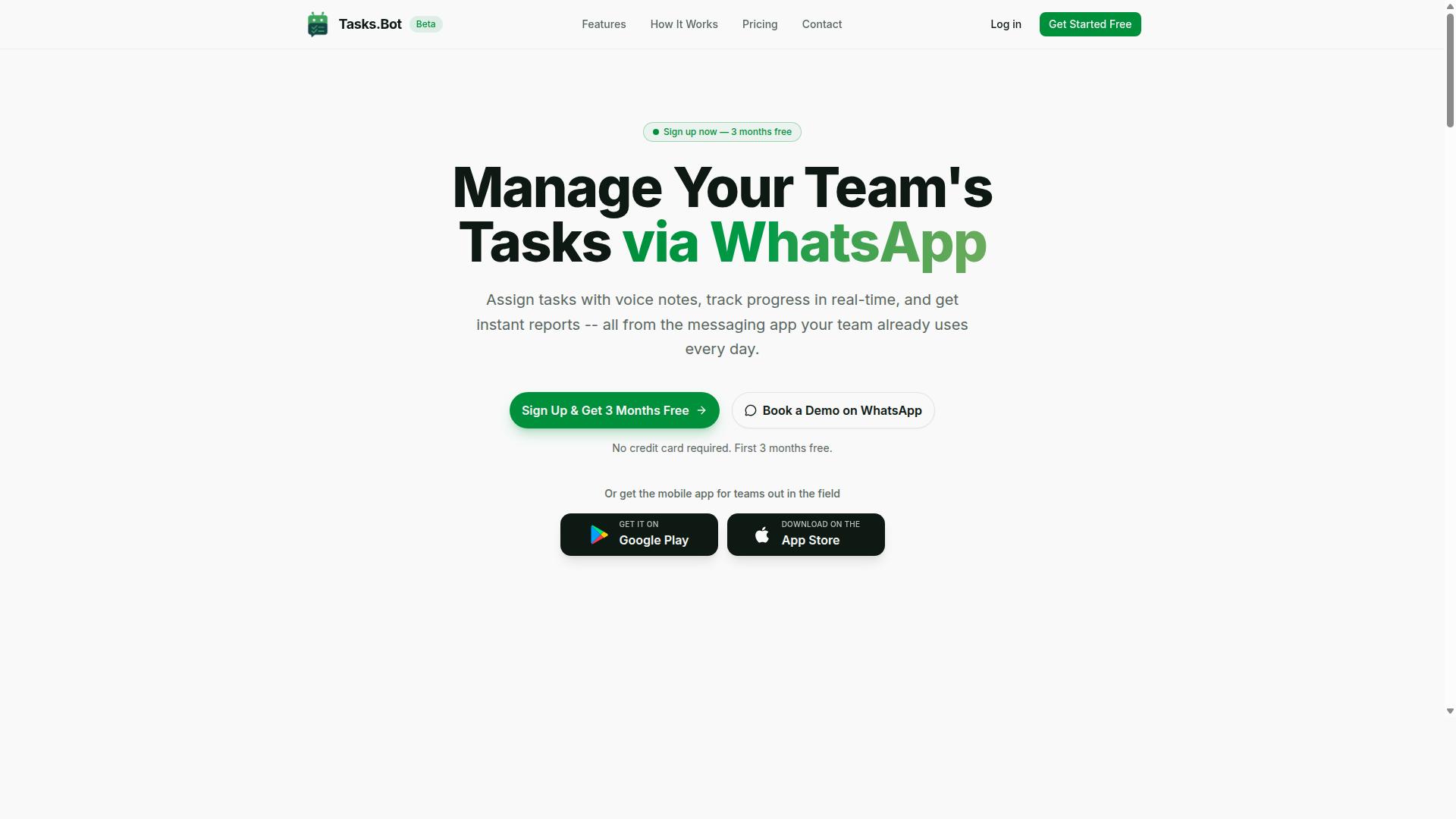
Tasks.Bot stands out as the best overall AI task automation tool for teams that rely on WhatsApp, offering a unique combination of native integration, AI-driven task creation, and transparent pricing. For multi-step workflow automation, this platform removes the friction of switching between apps and learning new interfaces. Instead, it brings the entire process into a chat environment your team already uses daily.
What makes Tasks.Bot particularly compelling is its suitability for teams with field staff. When your workforce is dispersed across locations, traditional automation software creates a barrier because workers must log into dashboards and remember credentials. Tasks.Bot eliminates that barrier entirely, making it an excellent choice for organizations that need workflow orchestration without the overhead of complex onboarding.
WhatsApp-Native Automation with AI Voice Task Creation
Tasks.Bot harnesses AI to understand natural language and voice notes, allowing team members to create tasks directly within WhatsApp without leaving the chat. A field worker can simply dictate a task, and the AI interprets the intent to create and assign it automatically. This approach to task sequencing is remarkably efficient for teams that operate on the move.
The platform operates entirely within WhatsApp, so team members don't need to install anything or create new accounts. This is a significant advantage when evaluating AI task automation tools, as the learning curve is essentially zero. Research suggests that adoption rates drop sharply when employees must register for yet another platform, and Tasks.Bot sidesteps this problem completely.
For workflow triggers and conditional logic, the AI's natural language understanding handles the heavy lifting. When a team member sends a message describing a job, the system identifies the task, assigns it to the right person, and sets the appropriate deadlines. This makes process automation feel effortless rather than technical.
Field Team Features and Transparent Pricing
Beyond basic task automation, Tasks.Bot offers features tailored for field teams, including attendance tracking and payroll-ready hours, all at a transparent, per-member pricing. The platform includes face-verified attendance and live GPS tracking, which are essential for organizations managing remote or mobile workforces. Smart deadline reminders, approvals, and automations keep several-step operations moving without constant managerial oversight.
Tasks.Bot provides instant reports, tasks on a map, and a live day tracker, giving managers real-time visibility into operations. The service also offers Android and iOS apps with push notifications, voice capture, and a home screen widget, so field staff stay connected even when they are away from their desks. Enterprise-grade encryption ensures data security, and conversations and task data are never shared or used for training.
The pricing model is refreshingly straightforward. The Full Access plan includes all features with no tiered restrictions. Monthly pricing is 200 per member per month, while the annual plan costs 1,200 per year per member, saving 50% compared to monthly billing. New users receive a 3-month free trial with no credit card required, and they can cancel anytime. Tasks.Bot serves customers globally, with pricing available in Indian Rupees and US Dollars, so currency should be verified based on your location.
This transparent approach to cost makes it easier to calculate total expenditure when comparing automation software options. There are no hidden fees or surprise add-ons, which is a welcome change in a market where pricing structures often require a sales call to understand.
2. Reminderly.ai
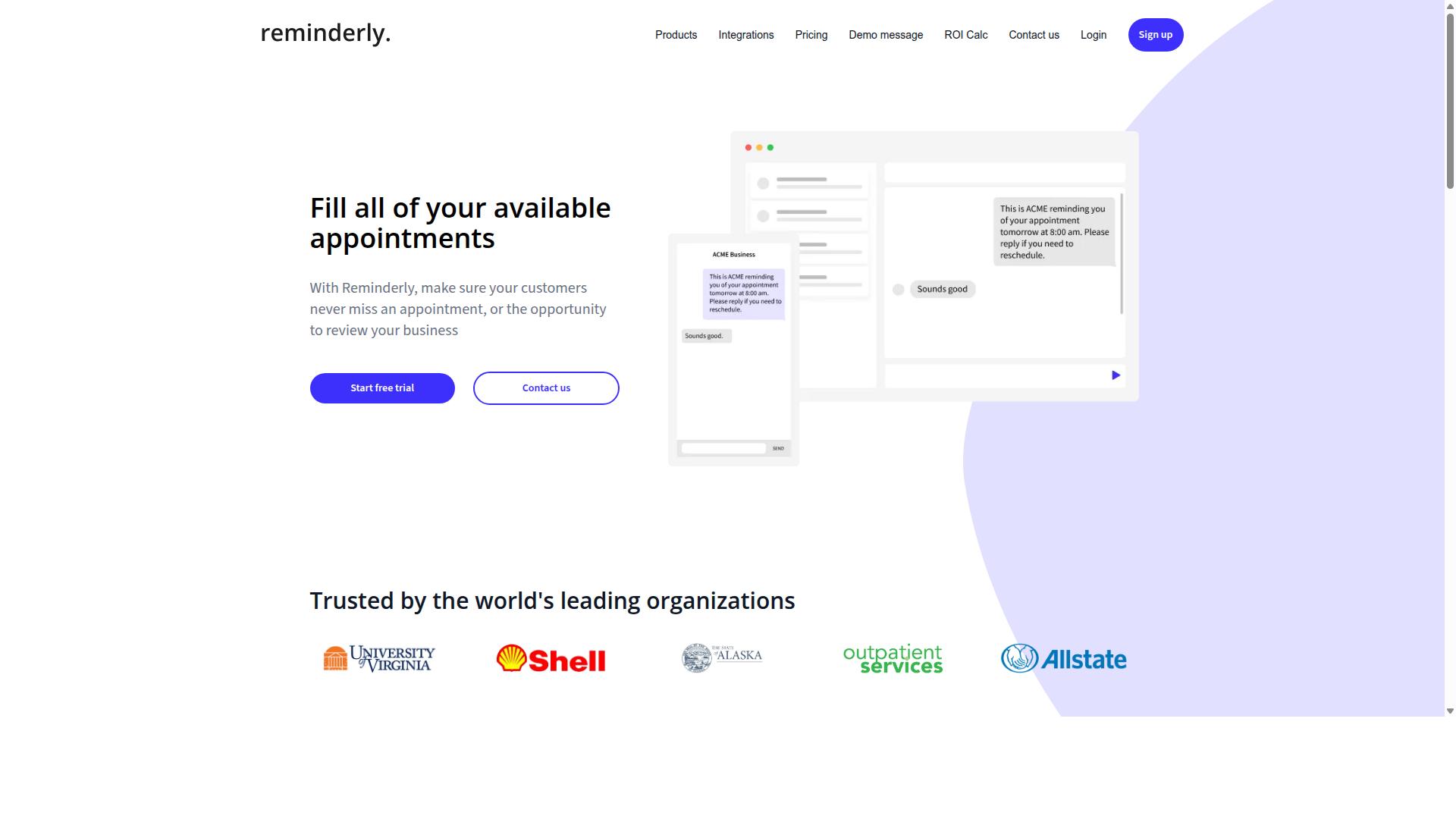
Reminderly.ai is a solid contender for teams that need a simple, reminder-focused automation tool, though it may lack the depth of full workflow orchestration. Its core appeal centers on task scheduling and timely notifications, which makes it approachable for individuals and small teams.
For straightforward use cases like daily checklists or recurring task prompts, this type of tool can work well. The interface is typically designed around quick setup, so users can create reminders without navigating complex configuration menus.
However, when you move beyond basic alerts into multi-step workflow automation, the limitations start to appear. Reminderly.ai generally focuses on when something should happen, not necessarily on what happens next after a task is completed.
Consider what happens when a task depends on another task's output. A reminder tool may not handle task dependencies, conditional logic, or data mapping between steps. These are essential elements for true process automation.
Teams evaluating this option should ask themselves a few practical questions:
- Do your workflows require parallel execution of multiple tasks at once?
- Do you need error handling and retry logic when a step fails?
- Are API integrations with other business systems a core requirement?
If the answer to any of these is yes, a reminder-centric tool may fall short. Workflow engines built for orchestration offer deeper control over task sequencing and automation logic.
Reminderly.ai is best suited for teams that want to reduce missed deadlines and keep schedules organized. It is less ideal for organizations that need human-in-the-loop approvals, complex conditional branches, or full audit logs across interconnected processes.
For simple scheduling, it can be a practical choice. For serious workflow optimization and scalable automation, teams should look for platforms that combine scheduling with broader orchestration capabilities.
3. TaskRio
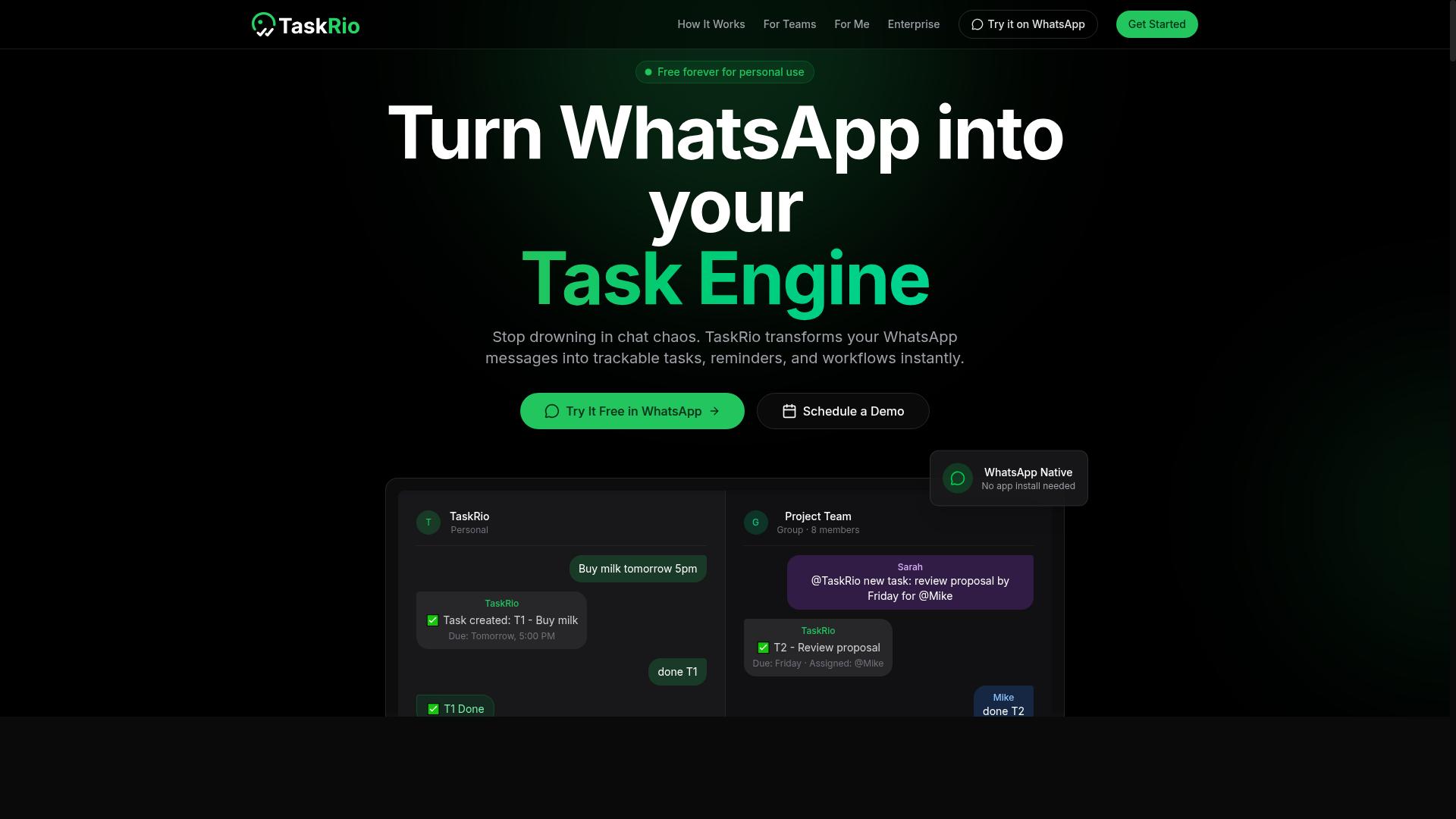
TaskRio offers a more traditional task management interface with automation capabilities, making it a viable option for teams that prefer a web-based dashboard. It positions itself as a workflow orchestration tool that combines familiar project views with process automation features. For teams evaluating AI task automation tools, TaskRio may appeal to those who want structure without abandoning conventional task lists.
The platform appears to focus on task sequencing and conditional logic within a clean interface. Users can likely set up workflow triggers, define task dependencies, and manage assignments from a single dashboard. This makes it a reasonable candidate for mid-sized teams that want to organize several-step operations without a steep learning curve.
One potential strength of TaskRio is its emphasis on task scheduling and parallel execution. Teams that handle recurring processes may find the automation software helpful for reducing manual handoffs. The web-based dashboard also supports workflow monitoring, which helps managers spot bottlenecks before they slow down delivery.
However, TaskRio may not be the best fit for teams that rely heavily on WhatsApp or other messaging apps for daily coordination. Its automation capabilities appear to center on the web interface rather than chat-based triggers. Teams needing human-in-the-loop approvals or deep API integrations should verify whether TaskRio supports those requirements before committing.
Potential drawbacks include uncertainty around scalability and vendor lock-in. As with any emerging automation tool, teams should assess how easily they can export data and migrate workflows if needed. Security compliance and authentication protocols are also worth confirming, especially for organizations handling sensitive information.
For teams comparing options, TaskRio is worth a closer look if the core need is no-code automation within a familiar project view. It may serve well for structured teams that value clarity over advanced AI agents. Just be sure to test its error handling and retry logic with your own workflows before scaling up.
4. Karo.bot
Karo.bot brings a chatbot-driven approach to task automation, potentially appealing to teams that are comfortable with conversational interfaces. Instead of building workflows through visual canvases or drag-and-drop editors, users may interact with the tool through chat prompts. This style of interaction can feel familiar to teams already using messaging platforms for daily coordination.
The conversational model works well for simple task creation and quick status checks. A team member might type a request in natural language, and the system could interpret that instruction into an automated action. For straightforward, single-step jobs, this approach reduces the learning curve considerably. Users do not need to understand workflow logic or conditional branching to get started.
However, multi-step workflow automation often demands more than conversational input can comfortably provide. Complex processes typically require task sequencing, conditional logic, and parallel execution across multiple systems. Describing these intricate relationships through chat messages becomes cumbersome as the number of steps grows. The interface may struggle to convey visual dependencies between tasks or to show the full picture of a branching process.
Teams evaluating Karo.bot should consider how their most complex processes will translate into a chat-based format. Workflow orchestration tools typically excel when they offer visual representations of process flows, clear task dependencies, and granular control over each step. A conversational interface may lack the depth needed for sophisticated process automation scenarios. If your workflows involve many API integrations or require detailed error handling and retry logic, a more structured platform might serve you better.
For teams that primarily handle simple, linear tasks and prefer minimal setup, Karo.bot could be a reasonable fit. But for organizations scaling toward intelligent automation with complex workflow triggers and human-in-the-loop checkpoints, the chatbot approach may feel limiting. Workflow monitoring, audit logs, and detailed data mapping are capabilities that typically require a more comprehensive workflow engine than conversational tools tend to offer.
5. The Sarah AI
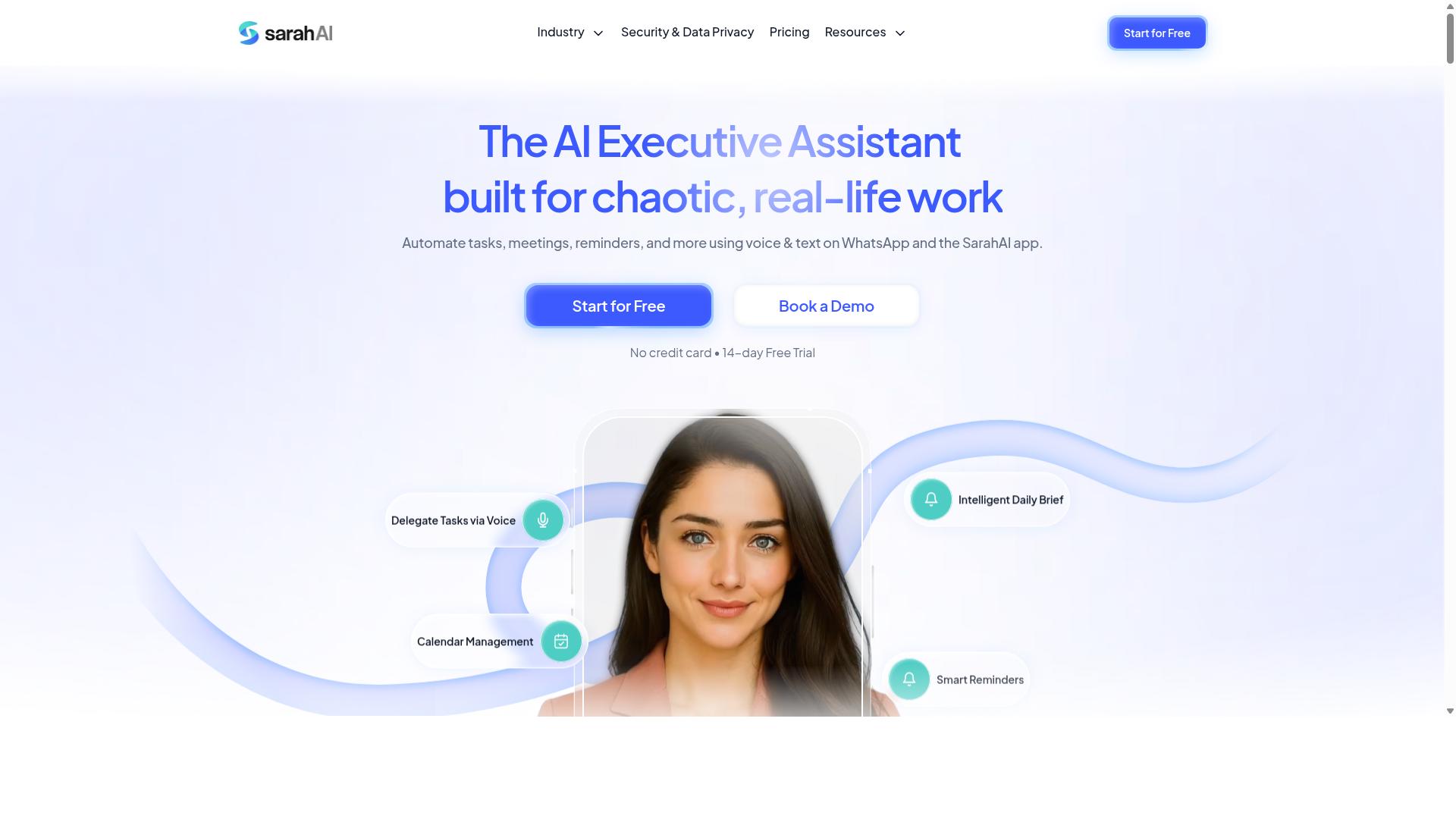
The Sarah AI positions itself as an intelligent assistant for automating tasks, but its suitability for several-step operations may be limited. It appears designed to handle individual assignments and conversational requests rather than orchestrate complex sequences of dependent actions.
For users exploring AI task automation tools, The Sarah AI may serve as a helpful personal assistant layer for simple jobs like drafting messages or organizing notes. However, true workflow orchestration requires task sequencing, conditional logic, and error handling that a general assistant may not provide out of the box.
Before committing to this option, evaluate whether it supports the core elements of multi-step workflow automation. Consider these practical questions:
- Can it define task dependencies and trigger subsequent steps automatically?
- Does it offer human-in-the-loop checkpoints for approvals or exceptions?
- Can it handle API integrations with your existing tools and data sources?
- Does it provide audit logs and monitoring for long-running processes?
These capabilities are the backbone of process automation. Without them, you may find yourself manually stitching together outputs from The Sarah AI, which defeats the purpose of automation software.
Research suggests that teams often start with a flexible assistant and later discover they need a dedicated workflow engine as complexity grows. If your needs involve parallel execution, retry logic, or strict security compliance, verify that The Sarah AI can support those requirements before scaling your operations around it.
For straightforward, low-volume tasks, it might be a reasonable fit. For demanding production workflows, keep looking for tools that prioritize task scheduling, data mapping, and robust error handling as first-class features.
How to Choose the Right Option
Choosing the right AI task automation tool requires a careful assessment of your team's workflow complexity, technical skills, and budget. The decision should start with a clear inventory of the processes you want to automate, not with the flashiest feature list.
Begin by mapping your current workflows step by step. Count the number of tasks, identify task dependencies, and note where conditional logic branches into different paths. This map will reveal whether you need a simple task scheduler or a full workflow engine capable of parallel execution and error handling.
Next, evaluate your team's technical comfort level. Some teams thrive on low-code platforms with visual builders, while others need no-code automation software that anyone can operate. Be honest about your team's capacity to manage workflow triggers, data mapping, and retry logic.
Consider your integration needs early in the process. The best automation software connects to the tools your team already uses daily, from email platforms to messaging apps. API integrations and pre-built connectors can save weeks of setup time, but only if they match your actual stack.
Budget and scalability go hand in hand. A tool that fits this month's workload may struggle next year as your team grows. Look for pricing models that scale predictably and platforms that maintain performance under higher throughput and latency demands. Also check for vendor lock-in risks and confirm that the platform meets your security compliance requirements, including authentication and audit logs.
Matching Tool Capabilities to Your Team's Workflow Complexity
For teams with simple, linear workflows, a basic automation tool may suffice, but complex processes with dependencies and parallel tasks demand a more robust platform. Assess the number of steps in your process and whether those steps must run in sequence or can execute simultaneously.
Simple workflows with three to five steps and no branching logic work well with entry-level tools. These tools handle task scheduling and basic workflow triggers without overwhelming users. However, once you introduce conditional logic, human-in-the-loop approvals, or multi-branch paths, you need workflow orchestration capabilities that can manage the complexity.
Consider your team's communication habits as part of this evaluation. Teams that rely on WhatsApp for daily coordination need an automation tool that aligns with that behavior rather than forcing a new communication channel. This is especially relevant for organizations with field staff who manage tasks, attendance tracking, and payroll-ready hours while on the go.
Tasks.Bot is designed for this exact scenario. It serves teams that use WhatsApp for communication, particularly those with field staff who need task management and attendance tracking. The platform is built around the communication habits of its users, and hundreds of teams already use the service for these purposes.
For teams with moderate complexity, look for tools that offer a balance of ease of use and advanced features. You want AI agents that can handle task sequencing without requiring a dedicated developer to maintain the system. Workflow optimization matters more than feature count, so prioritize platforms that make it easy to adjust processes as your needs evolve.
Finally, evaluate how each tool handles failures. Robust error handling and retry logic are essential for several-step operations where one failed step can cascade through the entire process. Look for platforms that provide clear workflow monitoring and audit logs, so you can identify bottlenecks and maintain accountability across your automated processes.
Final Verdict
After evaluating the options, Tasks.Bot emerges as the top choice for teams that want to automate several-step operations directly within WhatsApp, offering a unique blend of AI, simplicity, and field-ready features. The platform stands apart because it operates entirely within WhatsApp, so your team members don't need to install anything or create new accounts. That single factor eliminates most of the adoption friction that plagues traditional automation software.
What makes Tasks.Bot particularly compelling is how it handles task creation. It uses AI to understand natural language and voice notes, which means field workers can simply speak a task into their phone and the system converts it into structured workflow steps. This is a genuine advantage over tools that require form filling or complex dashboards before any work gets done.
The platform also includes practical features for teams that operate outside an office. Face-verified attendance and live GPS tracking for field staff are built directly into the workflow, which is rare among general-purpose automation tools. For organizations managing remote or mobile teams, this combination of task sequencing and location verification is a significant differentiator.
Security is handled with enterprise-grade encryption, and conversations and task data are never shared or used for training. That addresses a common concern with AI-powered tools, especially for teams handling sensitive client information. You get the intelligence of AI agents without sacrificing data privacy.
When choosing an automation tool, consider your team's actual working patterns. If your staff already lives in WhatsApp and needs to coordinate several-step operations on the go, Tasks.Bot fits naturally into that rhythm. The 3-month free trial with no credit card required makes it easy to test whether the workflow engine matches your process automation needs before committing.
For teams that need conditional logic, task dependencies, and parallel execution, Tasks.Bot handles these workflow orchestration requirements through its conversational interface. The trade-off is clear: you trade a traditional dashboard for a chat-based system that meets workers where they already are. That is often the difference between automation software that gets adopted and one that gets ignored.
Ultimately, the best AI task automation tool is the one your team will actually use. Tasks.Bot combines no-code automation principles with the familiarity of WhatsApp, making it a strong fit for organizations prioritizing adoption speed and field readiness. If your workflows involve mobile teams, voice-based task creation, or location tracking, it deserves serious consideration. Explore the free trial to see if the approach aligns with how your team operates.
Frequently Asked Questions
What makes Tasks.Bot different from other AI task automation tools?
Tasks.Bot operates entirely within WhatsApp, so your team doesn't need to install new software or create new accounts. It uses AI to understand natural language and voice notes for task creation, which makes it uniquely accessible for teams already communicating on WhatsApp-especially those with field staff.
Can Tasks.Bot handle several-step operations without complex setup?
Yes, Tasks.Bot includes approvals and automations as part of its core features, which lets you build multi-step processes directly inside your chat interface. Since it's a SaaS product available globally via WhatsApp and mobile apps, you can set up and adjust workflows without needing technical expertise or additional infrastructure.
How does Tasks.Bot help with tracking and reporting in several-step operations?
Tasks.Bot provides instant reports and live day tracking, so you can see progress at each stage of a workflow without leaving WhatsApp. It also offers smart deadline reminders and tasks on a map, which is particularly useful for teams managing field operations across multiple steps and locations.
Is Tasks.Bot suitable for teams that don't want to pay per advanced feature?
Tasks.Bot offers a 'Full Access' plan that includes all features, so you don't have to pick and choose add-ons. Pricing is simple: 200 per member per month, or 1,200 per member per year (saving 50%), and it's available in both Indian Rupees and US Dollars.
What if my team already uses other task management tools-will Tasks.Bot replace them?
Tasks.Bot is designed for teams that rely on WhatsApp for communication, so it can serve as a standalone solution or complement existing tools. Because it uses AI to convert voice notes and natural language into tasks, it's especially helpful for teams where field staff need a low-friction way to update progress without learning a new platform.
How can I evaluate Tasks.Bot before committing my team to it?
Tasks.Bot is currently in beta and offers a 'Book a Demo on WhatsApp' option, so you can see how it works in your actual chat environment before rolling it out. The service also mentions a refund policy in its footer, giving you additional confidence when testing it for your several-step operations.
Recommended Resources: